
Brain gym for kids: what it is and whether it works

In short
Brain gym for kids means short exercises where a child moves and thinks at the same time: cross-body steps, balance, hands doing different things, breathing, attention games. It is a fun, safe warm-up that practices coordination and following instructions. There is little solid evidence that it “trains the brain” or improves schoolwork, so nobody should promise that.
What brain gym includes
There is no single official list. Teachers and psychologists use the name for exercises borrowed from PE, music-and-movement classes and child neuropsychology. Six kinds come up most often.
- Cross-body movesThe right hand reaches for the left knee and the left hand for the right; marching on the spot with a tap on the opposite knee.
- BalanceStanding on one leg, walking along a line on the floor, carrying a soft toy on your head.
- Hands doing different thingsFist, edge, palm on the table; touching the thumb to each finger in turn; drawing with both hands at once.
- RhythmCopying a grown-up's claps and stamps, tapping out the beat of a rhyme.
- BreathingA slow breath in through the nose and a long breath out, “like a balloon going down”.
- Games with a ruleFreeze, “do the opposite”, “clap when you hear it”: the point is to hold back and not do the extra thing.
What is actually known about it
“Brain gym” sounds scientific, but it is neither a medical method nor a field of science. Explanations such as “this exercise connects the two hemispheres” or “switches the brain on” are a big simplification: both hemispheres work together during any movement anyway.
The best-known program of this kind is the commercial Brain Gym. Research reviews have not found reliable support for the idea that its exercises, by themselves, improve reading, writing or school results. For home routines there is even less data.
What can be said calmly:
- Children need to move every day, and a short warm-up is an easy way to add movement.
- An exercise where you listen, remember an order and manage your body is practice in attention and self-control, like any game with rules.
- Ten minutes with a grown-up who has put the phone away is the kind of attention children often miss.
So do it for the movement, the play and the time together, not for a “brain upgrade”.
How to do it at different ages
- Ages 3–4A minute or two, two exercises. Show the move and do it together; no “right” and “wrong” yet.
- Ages 5–6Five to seven minutes. Add counting out loud, rhythm and finger exercises.
- Ages 7–9Up to ten minutes. Make it harder: faster, “the opposite”, to music, counting tries.
- Ages 10–12A warm-up between homework tasks. Let your child lead the session and invent harder versions.
How to try it today
- Pick three exercisesFor example: march on the spot tapping the opposite knee, stand on one leg like a heron, and touch your thumb to each finger in turn.
- Show it and do it togetherSlowly at first. Children find it easier to copy a person than to follow an explanation.
- Stop while it is funA minute per exercise is enough. Tiredness and tears mean it is time to stop.
- Do it again tomorrow at the same timeHabits hang on a schedule: after preschool, before homework or before dinner.
If your child also finds it hard to stop and wait, see the guide to self-regulation games; for looking and listening, the attention games.
Safety and common sense
- Use a non-slip floor, bare feet or grippy socks, and move sharp corners and toys out of the way.
- Don't force it and don't compare your child with others: getting muddled in these exercises is normal.
- Don't expect the exercises to fix speech, handwriting or behavior, and don't put off a doctor's visit because of them.
- Games are not a substitute for professional advice. If you are worried about your child's development, behavior or sleep, talk to your pediatrician or a child psychologist.
How Iskorka helps with this
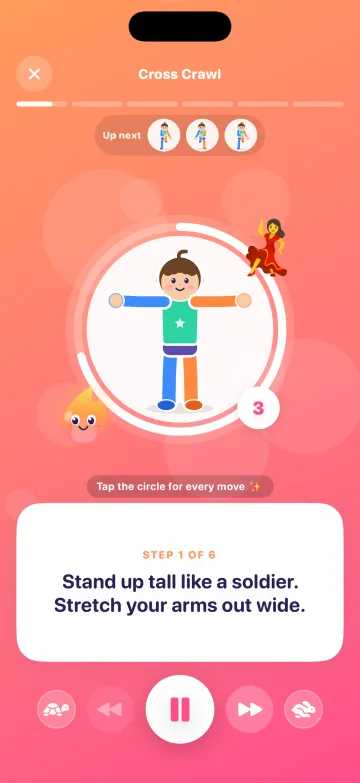
Iskorka puts exercises like these into a daily session of 5 to 20 minutes: a drawn figure shows the move while Sparky explains it out loud. Inside are Cross Crawl, Lazy Eight, Heron, drawing with two hands and attention games, with difficulty matched to your child's age. Every exercise and the main games are free. These are learning activities, not a medical service.
Common questions
What age can children start brain gym exercises?
Simple playful moves — clapping, cross-body steps, freeze games — suit children from about three. A minute or two at a time is plenty for little ones, and a grown-up always shows the move first.
How many minutes a day?
Five to seven minutes a day is enough for preschoolers, and about ten for school-age children. Doing it regularly and in a good mood matters more than the length: stop early rather than push on until your child is tired.
Can brain gym replace seeing a specialist?
No. These are movement and attention games, not a therapy program. If you are worried about your child's speech, behavior or learning, talk to your pediatrician or a child psychologist.
This guide is general information and does not replace advice from a doctor or psychologist. Iskorka offers learning exercises and games; it is not a medical service.