
Self-regulation games: helping your child learn to stop and wait

In short
Self-regulation is the ability to stop, wait, follow a rule and calm down after big feelings. It takes children years to build, and it is easier to practice through games than through lectures: games where you freeze, wait for a signal and do “the opposite”. Here are games you can set up at home today.
What self-regulation is made of
- stopping a movement when you hear “stop”;
- waiting for your turn;
- keeping a rule in mind while the game goes on;
- noticing and naming a feeling;
- calming down, first with a grown-up's help and later alone.
A small child calms down next to a calm grown-up, and that is part of the learning too: first “together”, then “by myself”.
Stop-and-go games
- Freeze DanceDance to music; when it stops, freeze like statues until it starts again.
- Traffic LightThree colored cards. Green means walk, yellow means march on the spot, red means stop. Then your child becomes the leader.
- Musical Statues with a themeWhen the music stops, freeze as an animal or a sea creature — and try not to laugh.
- Red Light, Green LightThe leader turns away and everyone creeps closer; the leader turns back and everyone freezes. Whoever moves goes back to the start.
“Opposite” and “wait” games
- Do the oppositeYou raise your arms, your child lowers theirs; you step forward, they step back.
- Don't say yes or noAnswer questions without ever saying “yes” or “no”. For children from about six.
- Simon SaysFollow the instruction only if it starts with “Simon says”. Without it, stay still.
- The quiet gameWho can stay silent while the sand timer runs? Start with thirty seconds.
Games about feelings
- Feelings thermometerDraw a scale from one to five, from “calm” to “about to explode”. Ask during the day, “Where are you now?” — and answer for yourself too.
- Guess the feelingTake turns showing joy, anger, surprise or hurt with face and body while the other guesses.
- BalloonA slow breath in and the tummy fills up; a long breath out and it goes down. More breathing games are in a separate guide.
What to choose by age
- Ages 3–4Freeze Dance and Traffic Light with two colors. Freezing for two or three seconds is enough.
- Ages 5–6Themed statues, Simon Says, Do the opposite, Guess the feeling.
- Ages 7–9Don't say yes or no, the quiet game, the feelings thermometer, board games with turns.
- Ages 10–12The same games at speed, with rules that change midway; talking about what helps them cool off.
What helps besides games
- A predictable daily routine: holding back is easier when you know what comes next.
- A five-minute warning before switching activities.
- Words for feelings: “you're angry because the tower fell”.
- Your own example: “I'm cross. I'll take a few breaths and come back.”
Keep in mind
- Don't use these games as a punishment, and don't start Freeze Dance when your child is already in tears.
- In the middle of a meltdown, safety and a calm grown-up nearby come first; games and talking come later.
- Don't shame a child for losing: everyone slips up in these games, grown-ups included.
- If outbursts are very frequent, your child hurts themselves or others, or you are finding it hard to cope, talk to your pediatrician or a child psychologist. Games are not a substitute for professional advice. If you are worried about your child's development, behavior or sleep, talk to your pediatrician or a child psychologist.
How Iskorka helps with this
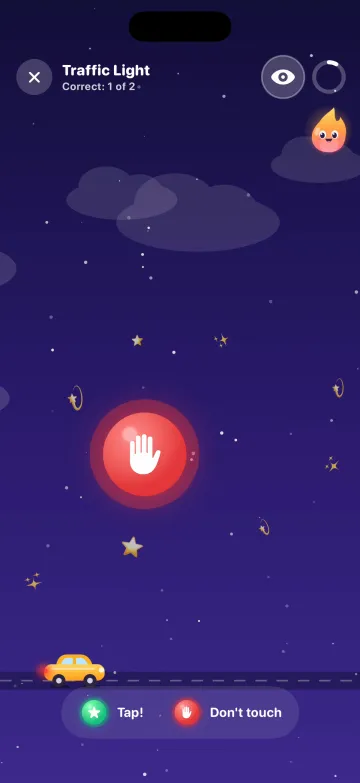
Iskorka has the same games in digital form. In Traffic Light you stop on red; in Freeze Dance the phone's motion sensors notice whether your child moved, as long as you hold it in your hand. For feelings there are Feelings Thermometer and Guess the Feeling, and Calm-down is a minute of breathing with Sparky. All of these are free. The Iskorka Plus subscription adds four-week programs, including Stop & Think and Calm.
Common questions
At what age can a child control themselves?
Little by little from three or four: in a game, a child can already freeze for a moment or wait for a turn. Holding back in everyday life takes far longer to grow, right through the preschool and school years. Meltdowns when a child is tired or hungry are ordinary.
My child gets angry when they lose. Should we keep playing?
Yes, but pick games with no loser: Freeze Dance can be everyone together against the music. Name the feeling out loud — “it's frustrating when it doesn't work” — and offer one more try. Losing well also comes with practice.
This guide is general information and does not replace advice from a doctor or psychologist. Iskorka offers learning exercises and games; it is not a medical service.