
Breathing exercises for kids: seven calm games

In short
The simplest breathing exercise for a child is a slow breath in through the nose and a long, soft breath out through the mouth, three to five times. Children find it easier to breathe “at something”: blowing up a pretend balloon, cooling hot soup, rocking a toy on the tummy. Teach the games at a calm moment, so they are easier to remember when things get hard.
Why bother
When a person is worried or angry, breathing gets fast and shallow. A slow, long breath out is a simple way of telling the body it can ease off, and many children and adults find it helps them calm down.
It is not a magic button. Breathing does not remove the reason for the tears, and it does not replace a hug or a grown-up's company. What it gives a child is something they can do for themselves.
Seven games
- BalloonHands on the tummy. Breathing in, the tummy fills like a balloon; breathing out, it slowly goes down with a “shhh”.
- Hot SoupCup your hands. Smell the soup with a breath in through the nose, then blow to cool it with a long breath out.
- Flower and CandleOne hand is a flower to smell. The other is a candle to blow on gently, so the flame only flickers.
- Toy on the tummyLying on the back: a soft toy rises on the in-breath and sinks on the out-breath.
- Finger breathingTrace the open fingers of one hand with a finger of the other: up a finger is a breath in, down is a breath out. Five fingers, five breaths.
- BeeBreathe in through the nose, and on the way out hum “zzz” or “mmm” quietly for as long as the air lasts.
- SquareFor children from seven. Draw a square with a finger: in for a count of three, pause for three, out for three, pause for three.
What to choose by age
- Ages 3–4Soap bubbles, a pinwheel, a feather on the palm: the breath out is visible. Two or three goes, and that's enough.
- Ages 5–6Balloon, Hot Soup, Flower and Candle, Toy on the tummy.
- Ages 7–9Finger breathing, Bee, Square with a short count.
- Ages 10–12A breath out longer than the breath in: in for three, out for five. Easy to do unnoticed, before a test or in a waiting room.
When and how to offer it
- Teach it at a calm moment, as a game, not as a task.
- Do it yourself, out loud: “I'm cross. I'm going to blow on my soup.”
- Tie it to moments of the day: before bed, before leaving the house, after preschool.
- In the middle of a meltdown, don't order “breathe!”. Stay close, breathe slowly yourself, and offer the game once the wave starts to pass.
For breathing as part of the evening, see how to calm a child before bed. Games about stopping and waiting are in the guide to self-regulation games.
If your child doesn't like it
It happens: some children find it funny, some find it boring, and some are annoyed by the very word “breathe”. Don't insist.
Let them pick what to blow on, bring out real soap bubbles or a pinwheel, or breathe along with a favorite toy. If breathing still isn't their thing, there are other ways to cool off: a drink of water, washing the face, a tight hug, squeezing and releasing the fists.
Safety
- No long breath-holding, especially for preschoolers.
- No fast, deep breathing many times in a row: it can make a child dizzy. If that happens, sit down and breathe normally.
- With asthma or other breathing conditions, ask your doctor which exercises suit your child.
- Don't force it, and don't use breathing as a punishment: “go and breathe and think about what you did”.
- Games are not a substitute for professional advice. If you are worried about your child's development, behavior or sleep, talk to your pediatrician or a child psychologist.
How Iskorka helps with this
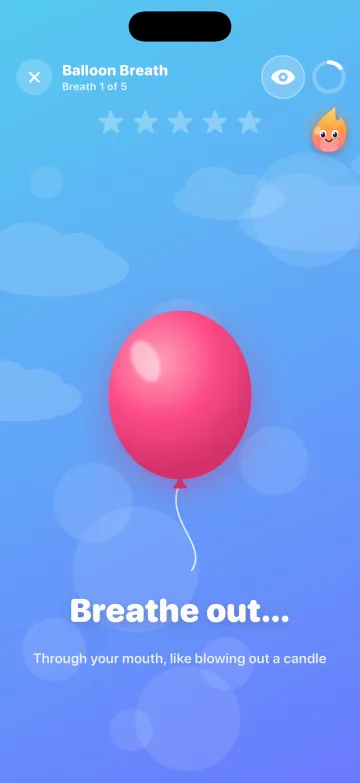
In Iskorka, breathing has its own games: Balloon Breath, where a balloon on the screen grows as you breathe in and shrinks as you breathe out, and Breathe Together. There is also Calm-down, a minute of breathing with Sparky for when feelings have already taken over. Everything is spoken aloud, works offline and is free. Some children find it easier to follow a balloon than an explanation, and later the same game works without a screen.
Common questions
What age can children start breathing exercises?
As a game, from about three: blowing on a feather, blowing bubbles, rocking a toy on the tummy. Exercises with counting and pauses suit school-age children.
How many breaths?
Three to five calm breaths in and out is usually enough — less than a minute. More is not better: if your child is bored or feels dizzy, stop.
My child refuses to breathe “on command”. What now?
Don't insist. Breathe slowly yourself, close by and out loud — children often fall in with you. Come back to the game later, at a calm moment, and let your child choose what to blow on.
This guide is general information and does not replace advice from a doctor or psychologist. Iskorka offers learning exercises and games; it is not a medical service.